Logistics & Mobility Startup Grants and Funding Programs in India — September 2026
Logistics & Mobility startups in India have access to 8 active grants, seed funds, and competitions in September 2026. These programs range from government-backed vehicle loan schemes to innovation challenges for deep-tech solutions.

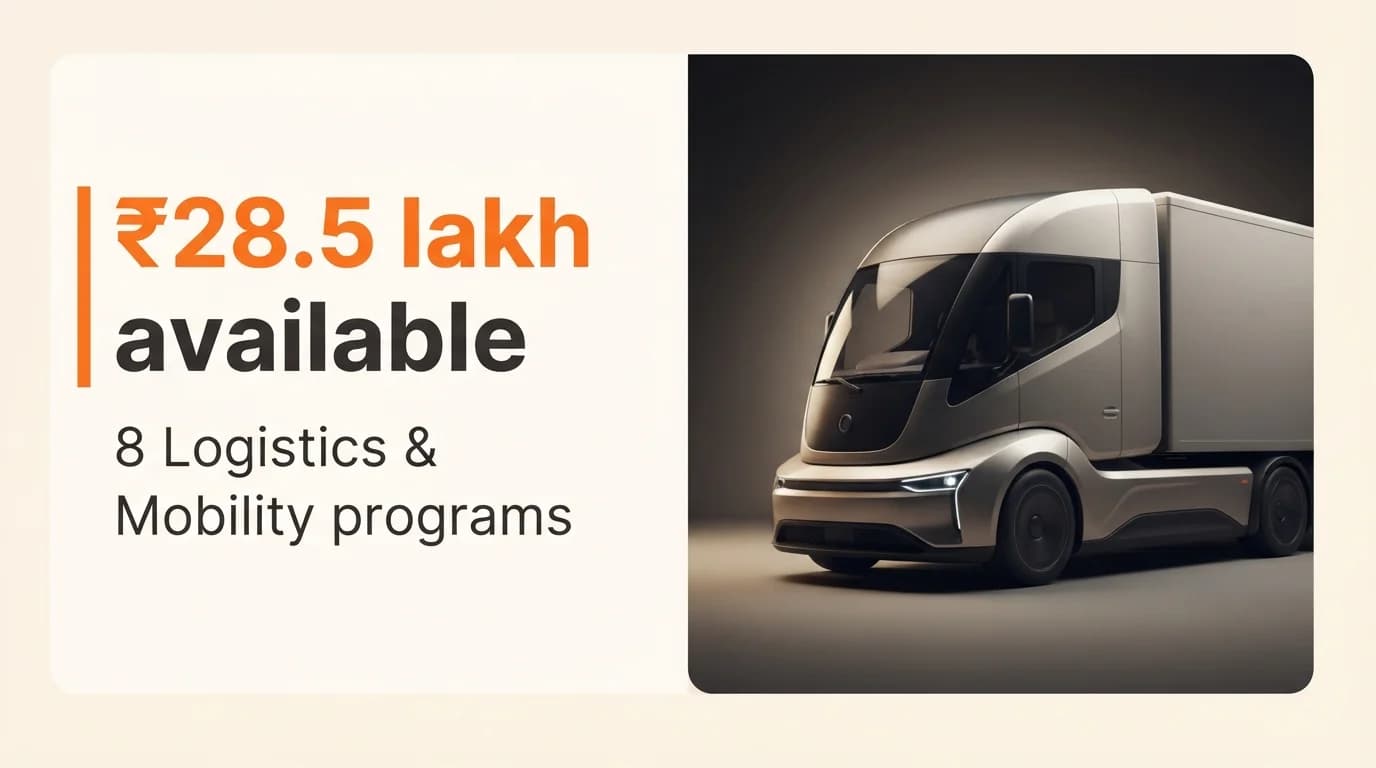
Eight active programs are currently available for Logistics & Mobility startups across India, encompassing grants, seed funding initiatives, incubation support, and innovation challenges. The funding landscape for Logistics & Mobility in India includes diverse opportunities. Government schemes provide direct financial assistance for vehicle acquisition and rural connectivity, while institutional programs offer pre-incubation, mentorship, and cash rewards. Specialized competitions target deep-tech solutions for specific industrial problems within the sector.
Active Logistics & Mobility Grants and Programs
| Program | Type | Deadline | Funding |
|---|---|---|---|
| Patent Reimbursement Incentives: Karnataka Startup Policy | Subsidy | Rolling | ₹2 L – ₹1 Cr |
| Jharkhand Mukhyamantri Gram Gadi Yojana | Grant | Rolling | Varies |
| Passenger Vehicle/Loading Vehicle Loan Scheme (DAADC) | Debt | Rolling | Varies |
| Vehicle Loan Scheme (GTKVN) | Debt | Rolling | ₹4 L |
| Jhota Buggi/Camel/Mule Cart Scheme (HSFDC) | Debt | Rolling | ₹1.5 L |
| Maruti Suzuki NURTURE Cohort 4 at IIM Calcutta Innovation Park | Competition | Rolling | ₹1.3 Cr |
| CoE Innovation Challenge: AI-Powered Foreign Object Detection in Bulk Cargo Unloaders | Competition | Rolling | Varies |
| Electropreneur Park OCP 3.0 Delhi | Grant | 6 Oct 2026 | Varies |

Patent Reimbursement Incentives (KBITS)
The Patent Reimbursement Incentives: Karnataka Startup Policy offers financial support for patenting costs. This program is for incubated startups officially registered with the Karnataka Startup Cell. KBITS, under the Government of Karnataka, manages this initiative. The policy aims to offset significant expenditures associated with securing intellectual property rights. Eligible startups can receive up to ₹10,00,000 for patent reimbursement. This support helps technology-driven ventures in Karnataka protect their innovations and maintain a competitive edge.
Jharkhand Mukhyamantri Gram Gadi Yojana (Transport Department, Government of Jharkhand)
The Jharkhand Mukhyamantri Gram Gadi Yojana, launched by the Transport Department, Government of Jharkhand, incentivizes private bus operators. Its goal is to improve rural connectivity by linking remote villages to block and district headquarters, educational institutions, medical facilities, and commercial centers. The program offers financial assistance and various exemptions to ensure the viability and expansion of bus services in underserved rural areas. This initiative supports operational costs for eligible bus operators and streamlines the permit process, fostering economic and social development.
Passenger Vehicle/Loading Vehicle Loan Scheme (DAADC)
The Passenger Vehicle/Loading Vehicle Loan Scheme (DAADC) provides financial assistance to unemployed individuals from Scheduled Caste (SC) Antyodaya families in Gujarat. Implemented by Dr. Ambedkar Antyodaya Development Corporation (DAADC) under the Social Justice and Empowerment Department, Gujarat, this loan facilitates the purchase of passenger or freight vehicles. The scheme supports the creation of self-employment opportunities within Gujarat's transport sector. It enhances economic inclusion and provides a pathway to sustainable livelihoods for marginalized communities by enabling the acquisition of essential transport assets.
Vehicle Loan Scheme (GTKVN)
The Vehicle Loan Scheme (GTKVN) targets youth from the Thakor and Koli communities in Gujarat. This initiative by the Gujarat Thakor and Koli Vikas Nigam (GTKVN), under the Social Justice and Empowerment Department, Government of Gujarat, provides financial assistance for acquiring commercial vehicles. Beneficiaries can establish or enhance income-generating transport businesses, promoting economic independence. The loan covers the purchase of various commercial vehicles, including auto-rickshaws, loading rickshaws, or Maruti Eeco vans, with funding up to ₹4,00,000.

Jhota Buggi/Camel/Mule Cart Scheme (HSFDC)
The Jhota Buggi/Camel/Mule Cart Scheme (HSFDC) is for individuals from Below Poverty Line (BPL) families in Haryana, both rural and urban, with an annual family income not exceeding ₹1,80,000. The Haryana Scheduled Castes Finance and Development Corporation (HSFDC), in collaboration with banks, implements this program. The scheme enables beneficiaries to purchase animal-driven carts (Jhota Buggis, camel carts, mule carts) for micro-enterprise activities like transporting goods or agricultural produce. It addresses financial barriers by providing support up to ₹1,50,000, fostering economic empowerment.
Maruti Suzuki NURTURE Cohort 4 (IIM Calcutta Innovation Park)
Maruti Suzuki NURTURE Cohort 4 is a joint pre-incubation initiative by Maruti Suzuki and IIM Calcutta Innovation Park (IIMCIP) for early-stage startups. While focusing on eastern, north-eastern, and central India, it is open to startups offering services anywhere in the country. The program focuses on domains like Mobility Convenience/Assistance, Tech in Mobility (ADAS, V2X, EV & EV infrastructure, autonomous mobility), Sustainability, Social Impact (rural mobility & development), and Enterprise & Manufacturing. It offers cash rewards worth ₹13,00,000, opportunities for paid Proof of Concepts (PoCs), mentorship from industry experts, and access to Maruti Suzuki's ecosystem.
CoE Innovation Challenge: AI-Powered Foreign Object Detection in Bulk Cargo Unloaders (NASSCOM CoE-IoT&AI)
The CoE Innovation Challenge: AI-Powered Foreign Object Detection in Bulk Cargo Unloaders by NASSCOM CoE-IoT&AI targets deep-tech startups. This initiative, with MeitY and state governments, seeks advanced solutions for industrial problems, specifically for port terminal operations. The current challenge addresses safety and efficiency in bulk cargo handling, focusing on detecting foreign objects within deep vessel holds during coal unloading. Solving this issue can prevent equipment damage and costly operational delays, making it relevant for startups with AI/IoT solutions for logistics.
Electropreneur Park OCP 3.0 Delhi (Electropreneur Park)
The Electropreneur Park OCP 3.0 Delhi is an Open Challenge Program designed to empower startups by solving real-world problems through innovative solutions. It identifies and supports aspiring and early-stage tech entrepreneurs in the Electronics System Design & Manufacturing (ESDM) domain across India. This program provides networking opportunities, seed funding, expert mentoring, and support for training, marketing, and patenting activities. Participants gain access to Electropreneur Park's CoE labs, specialized tools, software, and incubation facilities. The deadline for applications is 6 October 2026.

Before Applying
Applicants should review specific eligibility criteria before submitting. The Patent Reimbursement Incentives program requires startups to be registered with the Karnataka Startup Cell and incubated. Several vehicle loan schemes, including those from DAADC, GTKVN, and HSFDC, target specific communities or income groups, such as Scheduled Caste Antyodaya families in Gujarat or BPL families in Haryana. The NASSCOM CoE Innovation Challenge is directed towards deep-tech startups. Regarding application timelines, the Electropreneur Park OCP 3.0 Delhi has a firm deadline of 6 October 2026. Most other programs, such as the Jharkhand Mukhyamantri Gram Gadi Yojana, DAADC Vehicle Loan Scheme, GTKVN Vehicle Loan Scheme, HSFDC Jhota Buggi Scheme, Karnataka Patent Reimbursement, and Maruti Suzuki NURTURE Cohort 4, operate on a rolling or unspecified deadline basis, allowing for applications throughout the year.